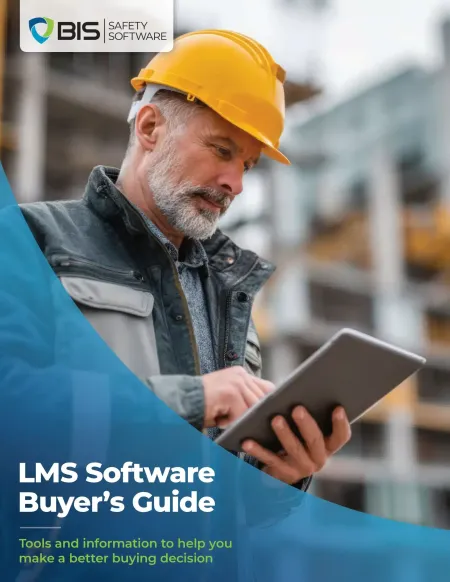
Learning Management System (LMS)
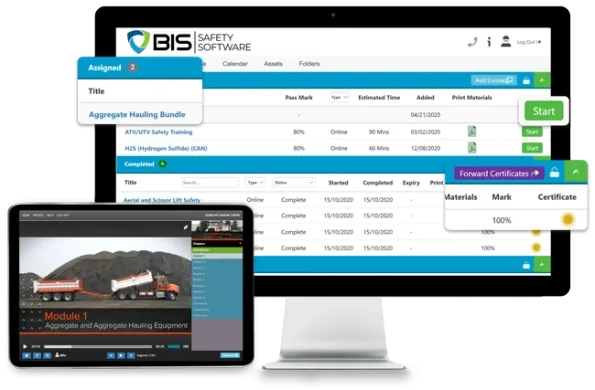
Your online training deployment system
A Full-Feature Learning Management System
A training deployment system with every feature you have come to expect from a Learning Management System, plus:
- Secure Cloud Hosting
- Mobile Compatibility
- Integrated Exam Engine
- API and SSO Integrations
- Enterprise-Level Scalability
- Access to Advanced Reporting Tools
See more
As part of BIS Safety Software’s powerful suite of tools, organizations gain access to a full-featured enterprise learning management system (LMS). This platform includes a robust exam engine, full SCORM compatibility, course branching, a comprehensive competency management system, and a role-based requirement mapping system that supports guided learning pathways.
What sets BIS Safety Software apart from traditional LMS platforms is the seamless integration of additional tools within the learning environment. Learners can upload historical training records directly within a course, complete required forms, submit documents, and input critical information that automatically routes to the appropriate system modules. This creates a streamlined, all-in-one experience where users can complete every step of their onboarding or training within a single orientation.
While the LMS is made to be flexible for any organization, it’s purpose-built for companies with complex safety and compliance requirements. Its design and features are tailored to meet the demands of high-risk industries, making BIS Safety Software an ideal solution for organizations operating in heavily regulated environments.
Competency Management
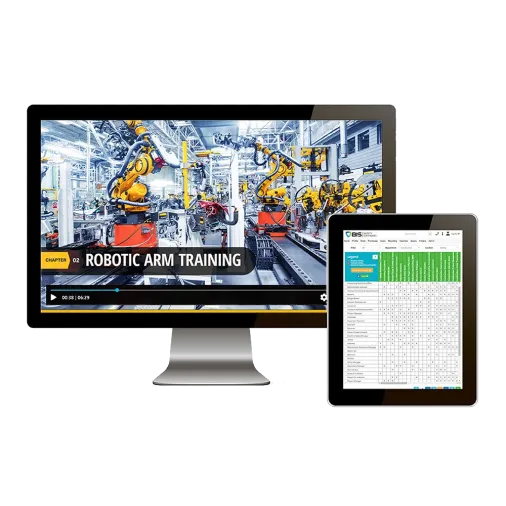
BIS Safety Software includes built-in competency management technology that goes beyond basic course completion tracking. Through the BIS Safety Software Learning Management System (LMS), training, assessments, certifications, and practical requirements are connected within a single competency framework aligned to specific job roles, worksites, and tasks. This ensures competency is defined by actual job requirements, not isolated learning events.
Competency status is tracked in real time, clearly showing whether individuals are qualified, conditionally qualified, or non-compliant for specific work. Expiries, prerequisites, and refresher requirements are automatically monitored, reducing the risk of overlooked certifications or outdated qualifications. Managers gain immediate visibility into workforce readiness across roles and locations.
By linking learning outcomes directly to job and site requirements, BIS Safety Software ensures training translates into verified capability and on-the-job readiness, not just attendance records. This approach supports defensible compliance, workforce planning, and safer task assignments.
Blended Learning Technology
BIS Safety Software supports true blended learning by seamlessly combining online training, instructor-led sessions, practical evaluations, and on-the-job verification within a single LMS platform. This allows organizations to design learning programs that reflect how skills are actually developed in the workplace.
Online courses, classroom sessions, toolbox talks, and hands-on assessments can all contribute toward a single learning path or competency requirement. Records from each learning method are automatically consolidated, giving administrators and supervisors a complete, centralized view of learner progress and qualification status.
Blended learning ensures flexibility for learners while maintaining consistency, traceability, and control for organizations. By managing all learning formats within the BIS Safety Software LMS, organizations can standardize training delivery, reduce administrative overhead, and ensure practical experience is captured alongside formal instruction.


Integrated Exam Engine
BIS Safety Software includes a fully integrated exam engine designed to assess knowledge accurately, consistently, and at scale. Exams can be customized using configurable question types, randomization rules, pass thresholds, time limits, and retake controls to meet internal policies or regulatory requirements.
Assessments can be aligned directly to courses, competencies, or specific regulatory standards, ensuring exam results are meaningful, auditable, and defensible. Exam outcomes automatically feed into certification and competency records within the LMS, eliminating manual updates and reducing the risk of data gaps.
By embedding assessments directly into the BIS Safety Software LMS, organizations ensure knowledge validation is reliable, standardized, and integrated into broader competency and compliance workflows.
AI Course Builder
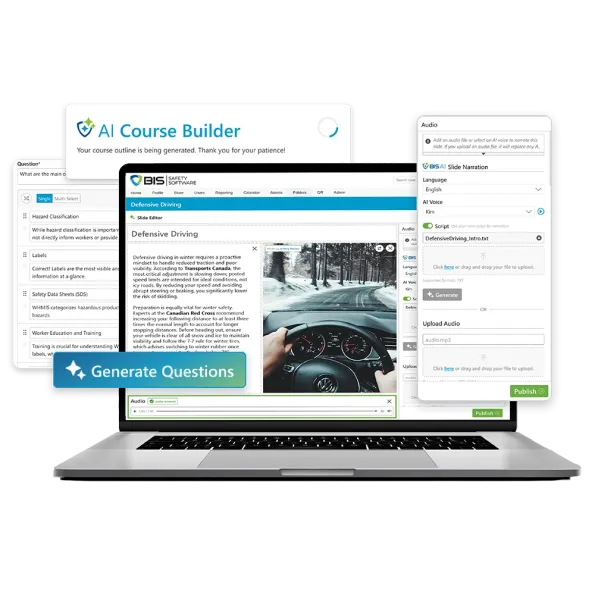
The BIS AI Course Builder enables organizations to rapidly create professional-grade training content using artificial intelligence. With a guided workflow, users can generate course material, images, voiceover narration, questions, and answers in a fraction of the time required by traditional authoring tools.
AI-generated content can be reviewed, edited, and customized to align with company standards, site requirements, and regulatory expectations. Courses can be deployed immediately and updated easily as requirements change.
The AI Course Builder reduces development effort, accelerates course creation, and helps organizations scale training without sacrificing quality.
Free Demos & Trial Accounts Are Available
1. How much does the BIS Safety Software LMS cost?
BIS offers flexible pricing to accommodate organizations of all sizes. The cost of the LMS depends on factors such as the number of users, the features and modules required, and whether you choose to include our online training content.
We offer several pricing models, including:
- Subscription-based LMS licensing for organizations requiring a comprehensive learning management solution.
- Pay-per-use pricing for organizations with occasional training needs.
- Content subscriptions that provide unlimited access to selected BIS courses for a fixed annual fee, offering significant savings for organizations with ongoing training requirements.
Our team will work with you to recommend the pricing model that best aligns with your organization’s size, training goals, and budget. Contact us for a customized quote.
2. How long does it take to implement the BIS LMS?
The implementation timeline for the BIS Learning Management System depends on the scope of your deployment, but most organizations are fully operational within 2 to 6 weeks.
For organizations implementing the LMS as a standalone solution, the process is often completed in as little as 2 to 3 weeks. More complex deployments that include integrations with HRIS systems, custom learning pathways, data migration, branded portals, competency frameworks, or additional BIS modules typically take 4 to 6 weeks, depending on the level of customization required.
Our implementation process is designed to be collaborative and efficient, and generally includes:
- Discovery and project planning
- Configuration of your branded LMS portal
- User and training record imports
- Course library configuration and learning pathways
- Administrator training
- User acceptance testing
- Go-live support
A dedicated implementation specialist guides your team through each stage of the project to ensure a smooth rollout with minimal disruption to your operations.
If you have a specific deadline, such as a regulatory audit, onboarding initiative, or company-wide rollout, we can work with you to develop an accelerated implementation plan wherever possible.
3. Can we migrate our existing training records into the BIS LMS?
Yes. BIS can migrate your existing training records into the Learning Management System, making it easy to preserve your organization’s historical training data and maintain a complete employee training history.
We offer several options for importing training records, depending on how your information is currently stored:
- Bulk data imports from spreadsheets (such as Excel or CSV files) for employee profiles, training records, certifications, and expiry dates.
- Migration from your existing LMS or training management system, where data can be mapped and imported into BIS.
- Certificate uploads through online courses, allowing learners to upload proof of completion for externally completed training. Once reviewed and approved, these records are automatically added to the employee’s training transcript.
- Employee self-submission through the BIS Safety App or user profile, enabling workers to upload certificates and supporting documentation for administrator review and approval.
- Ongoing imports through system integrations, using the BIS API to synchronize employee and training data with HRIS, ERP, or other business systems where required.
Our implementation team works with you to map your existing data, validate the import, and ensure training histories, certifications, completion dates, and renewal dates are accurately transferred. This allows you to maintain historical compliance records while providing employees and administrators with a single, centralized training transcript going forward.
4. How is the BIS LMS different from a general-purpose LMS?
Unlike a general-purpose Learning Management System, the BIS LMS was purpose-built for organizations that need to manage workforce training, competency, and regulatory compliance, particularly in safety-critical industries such as construction, energy, manufacturing, transportation, mining, municipalities, and industrial services.
While traditional LMS platforms focus primarily on delivering online learning, the BIS LMS combines learning management with a comprehensive workforce compliance platform.
Key differences include:
Compliance-driven training management
The BIS LMS automatically tracks certifications, licence expiries, competencies, and mandatory training requirements. Training can be assigned based on job title, department, location, trade, or custom workforce attributes, helping ensure every worker completes the training they need to remain compliant.
Integrated training record management
In addition to online courses, BIS manages classroom training, practical evaluations, third-party certifications, and uploaded training records, providing each worker with a complete training transcript in one centralized system.
Automated training pathways and matrices
Create role-based learning paths, onboarding programs, and training matrices that automatically assign required learning and notify workers and administrators before certifications expire.
Purpose-built for safety and operations
Because the LMS is part of the broader BIS Safety Software platform, training is directly connected to safety operations, including digital forms, inspections, incidents, competency management, assets, document management, and other compliance workflows.
Extensive safety course library
Organizations have access to more than 1,800 online training courses, covering health and safety, regulatory compliance, HR, professional development, and industry-specific topics. You can also upload and manage your own custom training content.
Flexible learning delivery
Deliver training online, in a classroom, through blended learning, or by assigning practical competency assessments. Employees can also upload certificates from external training providers for approval and inclusion in their training records.
Built for the field
Employees and supervisors can access training records, certificates, and compliance information from the BIS Safety App or web portal, making it easy to verify qualifications wherever work is being performed.
Enterprise integration
The BIS LMS integrates with HRIS, ERP, payroll, identity management, and other business systems through our API, allowing employee information and training data to remain synchronized across your technology ecosystem.
Rather than simply delivering courses, the BIS LMS helps organizations ensure the right people have the right qualifications at the right time. By combining learning management with automated compliance tracking and workforce management, BIS provides a complete solution for managing employee competence and maintaining audit readiness.
5. Can we use the BIS LMS to train contractors and other external workers?
Yes. The BIS LMS is designed to support training for employees, contractors, visitors, and other external workers.
You can assign training, orientations, and compliance requirements to contractors just as you would for employees, while maintaining separate user groups and reporting. Contractors can access training online from any device, complete required courses, upload supporting documentation where applicable, and receive certificates upon completion.
The platform also allows you to track training status, certifications, and expirations, helping ensure that everyone working on your sites meets your organization’s training and compliance requirements before they arrive. This makes the BIS LMS an ideal solution for organizations that manage a mixed workforce of employees, contractors, and subcontractors.
6. Does the BIS LMS support different administrator permission levels?
Yes. The BIS LMS supports role-based administrator permissions, allowing organizations to control exactly what each administrator can see and do within the system.
Rather than providing every administrator with full access, permissions can be tailored based on job function, department, business unit, or location. This helps maintain data security while ensuring users have access only to the information they need.
Examples of administrator roles include:
- Corporate administrators with full system access across the organization.
- Regional or site administrators who manage only workers at specific locations.
- Department or division managers who can assign and monitor training for their own teams.
- Supervisors who can view employee compliance status, approve external training submissions, and monitor progress.
- Instructors who can manage classroom sessions, attendance, evaluations, and course completions without accessing broader system settings.
Permissions can be configured to control access to features such as:
- User and employee management
- Course assignment and enrolment
- Training records and certifications
- Learning pathways and training matrices
- Reports and dashboards
- Classroom training management
- Approval of externally submitted training records
- System configuration and administration
- Content and course management
Because the BIS LMS is part of the broader BIS Safety Software platform, administrator permissions can also extend across other modules, including Digital Forms, Training Record Management, Document Management, Asset Management, and Incident Management, allowing organizations to maintain a consistent security model throughout the system.
This flexible permission structure supports organizations of all sizes, from a single-site operation to large enterprises with multiple business units, ensuring the right people have the right level of access while protecting sensitive employee and compliance data.
7. How is our data secured, and where is it hosted?
BIS is committed to protecting your organization’s data through industry-leading security practices and trusted cloud infrastructure.
Our LMS is hosted on Amazon Web Services (AWS) Canada, ensuring your data remains in secure Canadian data centres and helping organizations meet strict data residency and privacy requirements.
BIS is also SOC 2 compliant, demonstrating our commitment to maintaining rigorous standards for security, availability, and the protection of customer data. Our security controls and processes are independently audited to ensure they meet recognized industry standards.
The BIS LMS incorporates multiple layers of security, including:
- Secure hosting on AWS Canada.
- Encrypted data transmission using HTTPS/TLS.
- Role-based access controls to ensure users only have access to the information they need.
- Continuous system monitoring, security updates, and vulnerability management.
- Automated backups and disaster recovery processes to help protect against data loss.
- Audit trails and activity tracking to support accountability and compliance.
Administrators have full control over user permissions and access levels, ensuring training records and sensitive information are only accessible to authorized personnel.
If your organization has specific security, compliance, or data residency requirements, our team can provide additional documentation and answer any questions during the implementation process.
8. Can the BIS LMS help us stay audit-ready, including for COR?
Yes. The BIS LMS is designed to help organizations maintain continuous compliance and remain audit-ready, including supporting the documentation and training requirements commonly associated with COR (Certificate of Recognition) and other regulatory or industry-specific audits.
By centralizing all employee training records, certifications, competency assessments, and supporting documentation in a single system, BIS provides a clear, verifiable record of workforce qualifications that can be accessed whenever an audit is required.
Key audit-ready features include:
- Centralized training records that capture online training, classroom sessions, practical evaluations, and third-party certifications in a single employee transcript.
- Automated expiry tracking and renewal notifications to help ensure certifications remain current and reduce the risk of non-compliance.
- Training matrices and learning pathways that automatically assign required training based on job role, department, location, or other workforce attributes.
- Digital certificate storage, allowing employees or administrators to upload external training certificates and supporting documentation for review and inclusion in the employee’s record.
- Comprehensive reporting and dashboards that provide real-time visibility into workforce compliance, overdue training, upcoming expiries, and completion rates.
- Detailed audit trails that record training completions, assignments, approvals, and administrative actions, helping demonstrate due diligence.
- Document management integration, allowing policies, procedures, safe work practices, and other compliance documents to be managed alongside employee training records.
- Role-based permissions to ensure sensitive information is securely managed while still allowing supervisors, managers, and auditors access to the information they require.
Because the BIS LMS is part of the broader BIS Safety Software platform, organizations can also connect training records with digital inspections, hazard assessments, incidents, corrective actions, and other safety management activities. This creates a more complete compliance record that supports not only COR audits, but also ISO standards, client prequalification programs, regulatory inspections, and internal compliance reviews.
Rather than preparing for audits at the last minute, BIS helps organizations maintain audit readiness year-round by ensuring training records, supporting documentation, and compliance reporting are always current, organized, and readily accessible.
9. What systems does the BIS LMS integrate with?
The BIS LMS is designed to integrate with a wide range of business systems, helping automate user management, simplify administration, and keep your training and employee data synchronized across platforms.
Common integrations include:
- Human Resource Information Systems (HRIS) for automated employee onboarding, updates, and offboarding.
- Single Sign-On (SSO) providers, including Microsoft Entra ID (Azure AD) and other SAML- or OAuth-compatible identity providers, allowing users to securely access the LMS with their existing corporate credentials.
- Payroll and enterprise systems, including integrations with platforms such as ADP, BambooHR, Oracle JD Edwards, UKG (UltiPro), Infinium HR, and My Workplace.
- SCORM-compliant learning content, enabling organizations to import and deliver third-party eLearning content.
- REST API integrations, allowing organizations to connect the BIS LMS with internal business applications and automate data exchange, including user provisioning, course assignments, training completions, reporting, and organizational structure updates.
For organizations with custom integration requirements, BIS provides comprehensive API documentation to support developers and implementation teams. The documentation is available at: BIS Safety Software API Guide
Our implementation team will work with you to determine the most effective integration strategy based on your existing systems and business requirements. If you have a specific application or software platform in mind, we can assess compatibility and recommend the best integration approach.
10. How does the BIS LMS decide what training each worker needs?
The BIS LMS uses configurable training matrices and automated learning pathways to determine what training each worker requires. Rather than manually assigning courses to individual employees, organizations can define training requirements based on the attributes that are most relevant to their workforce.
Training can be assigned automatically using criteria such as:
- Job title or position
- Department or business unit
- Work location or project
- Trade or occupation
- Employment type (employee, contractor, temporary worker, etc.)
- Supervisor or reporting structure
- Custom employee fields unique to your organization
When a new worker is added to the system, or an existing employee changes roles, locations, or departments, the BIS LMS can automatically assign the appropriate onboarding program, mandatory training, refresher courses, and competency requirements based on the rules you’ve configured.
The system also continuously monitors training status and certification expiry dates. As training approaches its renewal date, automated notifications and reminders are sent to employees and administrators, helping ensure qualifications remain current and reducing the risk of compliance gaps.
For organizations with unique operational requirements, training matrices can be customized to reflect company-specific standards, client requirements, regulatory obligations, or site-specific training. This flexibility allows businesses to automate everything from new-hire onboarding to complex competency management programs across multiple locations.
By automating training assignments and compliance tracking, the BIS LMS helps ensure every worker has the right training for their role while reducing administrative effort and maintaining a consistent, organization-wide approach to workforce compliance.
1. Can we create our own courses, or do we have to use BIS's content?
Yes. You can absolutely create and deliver your own training content, you’re not limited to using BIS’s course library.
The BIS LMS gives organizations the flexibility to combine their own custom training with BIS’s extensive catalogue of more than 1,800 online courses, allowing you to build a learning program that meets your organization’s specific needs.
You can create and manage:
- Company-specific orientation and onboarding programs
- Standard operating procedures (SOPs)
- Safe work practices and job procedures
- Equipment and machinery training
- Site-specific or client-specific training
- HR and corporate policy training
- Product knowledge and operational training
- Leadership and professional development courses
The platform includes an AI Course Builder that can help accelerate course creation by generating structured training content, learning objectives, knowledge checks, and quizzes. You can then review and customize the content to align with your organization’s policies and procedures.
You can also upload existing training materials, including presentations, videos, PDFs, documents, images, and other learning resources, and organize them into interactive online courses. Course creators can incorporate quizzes, exams, acknowledgements, certificates, and completion requirements to ensure learners have understood the material.
For organizations with existing eLearning content, the BIS LMS also supports SCORM-compliant courses, making it easy to migrate and continue using training you’ve already developed or purchased.
Many organizations choose a blended approach: using BIS’s ready-made compliance and safety courses while developing their own company-specific content. This provides a single platform for managing all workforce training and maintaining a complete employee training record, regardless of where the content originated.
2. How does the BIS LMS keep online exams credible?
The BIS LMS includes multiple features to help maintain the integrity and credibility of online exams while providing a fair, secure, and consistent assessment experience.
These features include:
- Question randomization – Questions are presented in a randomized order to reduce the likelihood of users sharing answers.
- Randomized answer choices – Multiple-choice responses can also be randomized to discourage memorization.
- Question pools – Exams can draw questions from a larger question bank, ensuring each learner receives a unique assessment.
- Passing score requirements – Administrators can define the minimum score required to successfully complete an exam.
- Time limits – Exams can be configured with time limits to encourage knowledge recall rather than answer searching.
- Controlled retakes – Organizations can limit the number of exam attempts and configure waiting periods between retries.
- Automatic grading and recordkeeping – Exam results, scores, completion dates, and certificates are automatically recorded in each user’s training history.
- Audit trail – The system maintains a complete record of training activity and exam completion to support compliance and audit requirements.
For organizations requiring an additional level of exam security, BIS also offers an optional virtual proctoring solution. Virtual proctoring uses the learner’s webcam and microphone to help verify participation throughout the course or exam. The solution monitors the learner’s engagement and environment, helping organizations confirm that the registered individual is actively completing the training and assessment. This is particularly valuable for high-stakes training, regulatory compliance, and programs where identity verification and exam integrity are critical.
Together, these features help organizations deliver secure, defensible online assessments while supporting internal policies and regulatory training requirements.
3. Does the BIS LMS work on mobile and out in the field?
Yes. The BIS LMS is fully accessible from desktops, tablets, and smartphones, allowing employees to complete training and manage their learning from virtually anywhere with an internet connection.
The BIS Mobile App extends the platform’s capabilities to workers in the field, enabling them to:
- Complete assigned online training and orientations.
- Access training records, certificates, and learning history.
- Upload training certificates and supporting documentation for administrator review.
- View assigned and completed training.
- Receive notifications for upcoming training and certification renewals.
- Access digital certificates and proof of training while in the field.
The LMS is a cloud-based solution and requires an internet connection to access online courses, complete training, and synchronize learning records. This ensures that course completions, certifications, and reporting are updated in real time and are immediately available to both learners and administrators.
Whether employees are working in the office, at a job site, or remotely, the BIS LMS provides a consistent and secure learning experience across all supported devices.
4. Can we deliver training in more than one language?
Yes. The BIS LMS supports multilingual training, allowing organizations to deliver learning in the language that best meets the needs of their workforce.
Many courses within the BIS library are available in multiple languages, including English, French, and Spanish, with additional languages available for select course titles. Language availability varies by course, and our team can help identify the options that best fit your training requirements.
For your own custom training, you can create and manage courses in virtually any language. The LMS supports multilingual text, documents, videos, quizzes, and other learning content, allowing you to develop organization-specific training for diverse workforces.
Employees can complete training in their preferred language where multilingual versions are available, helping improve comprehension, engagement, and overall learning outcomes, particularly for organizations with multilingual or international teams.
If your organization requires specific languages, our team can work with you to identify existing multilingual content or discuss translation options for your custom training materials.
5. How are completion certificates issued and verified?
When a learner successfully completes a course and meets all completion requirements, such as viewing the required content and achieving the minimum passing score on the final exam, the BIS LMS automatically generates a digital certificate of completion.
Certificates are immediately added to the learner’s training transcript and can be viewed, downloaded, or printed at any time by both the employee and authorized administrators.
Each certificate contains key training information, including:
- Employee name
- Course title
- Completion date
- Certificate or credential number (where applicable)
- Expiry or renewal date (if applicable)
- Course provider
- Additional course-specific information, depending on the training
For organizations tracking external or third-party training, employees can upload certificates directly through an online course or from their user profile or the BIS Safety App. These submissions can be routed through an approval workflow, allowing an administrator to verify the documentation before it is added to the employee’s official training record.
Administrators can quickly verify training completion and certificate status through employee transcripts, training reports, and compliance dashboards, making it easy to confirm qualifications during audits, site access checks, client requests, or regulatory inspections.
By centralizing both BIS-issued certificates and externally verified credentials in a single system, the BIS LMS provides a complete, accurate, and auditable record of each employee’s training and qualifications.
6. How do we schedule and manage instructor-led or classroom sessions?
The BIS LMS includes a comprehensive Classroom Calendar module that makes it easy to schedule, deliver, and manage instructor-led training alongside your online learning programs.
Administrators can create classroom sessions for any course, assign instructors, set maximum class sizes, manage waitlists, and track registrations from a centralized calendar. Sessions can be delivered at your own facilities, client sites, or virtual meeting platforms.
The Classroom Calendar allows you to:
- Schedule one-time or recurring classroom training sessions.
- Assign instructors, locations, rooms, and equipment.
- Set participant capacity and manage waitlists.
- Allow employees to self-register or assign learners directly to a session.
- Send automated registration confirmations, reminders, and schedule updates.
- Record attendance and training completion.
- Capture practical evaluations, competency assessments, and instructor notes.
- Issue completion certificates and automatically update employee training records.
- Track instructor availability and upcoming classroom events through a centralized calendar.
Instructor-led training is fully integrated with the BIS LMS, meaning classroom sessions, online courses, practical assessments, and third-party certifications are all maintained within a single employee training transcript. This provides a complete view of each worker’s qualifications regardless of how the training was delivered.
For organizations that deliver both online and in-person training, the BIS Classroom Calendar provides a single platform to manage all learning activities while reducing administrative effort and ensuring training records remain accurate and audit-ready.
7. Can we rely on AI-generated courses for compliance training?
The BIS AI Course Builder is designed to accelerate course development, but it does not automatically publish AI-generated content.
Instead, the AI creates a draft course storyboard that includes a structured outline, learning objectives, lesson content, knowledge checks, and assessment questions based on the information you provide. This draft then enters your organization’s course development workflow, where designated course administrators or subject matter experts review, edit, and approve the content before it can be published to learners.
This review process ensures that all training content is accurate, current, aligned with your organization’s policies and procedures, and compliant with applicable regulatory requirements before it is delivered.
For compliance and regulatory training, BIS recommends that organizations use the AI Course Builder to significantly reduce the time required to develop a high-quality first draft, while relying on qualified health and safety professionals, instructional designers, or subject matter experts to validate the final content prior to publication.
Many organizations also choose a blended approach, using BIS’s professionally developed compliance course library for legislated or industry-standard training, while leveraging the AI Course Builder to rapidly create company-specific onboarding, policies, procedures, equipment training, and operational content.
This approach combines the speed and efficiency of AI with the oversight and quality assurance needed to ensure training content is reliable, compliant, and ready for deployment.
8. What happens when a learner fails an exam or needs to retake it?
The BIS LMS provides flexible exam management, allowing organizations to define what happens when a learner does not achieve the required passing score.
Course administrators can configure exam rules to match their organization’s training policies, including:
- Minimum passing scores.
- The number of exam attempts permitted.
- Required waiting periods between attempts.
- Whether learners must review the course content before attempting the exam again.
- Automatic notifications to learners and administrators when an exam is failed.
If a learner does not pass an exam, the system records the attempt and allows them to retake the assessment according to the rules established for that course. Once the learner achieves a passing score, the course is marked as complete, their training transcript is updated, and a completion certificate is issued automatically where applicable.
Administrators can also monitor exam results through reporting and dashboards to identify learners who may require additional coaching or support, as well as courses where pass rates suggest improvements to the training content may be beneficial.
This flexible approach allows organizations to balance learner success with the integrity of their training program while ensuring compliance with internal policies and regulatory requirements.
9. How do learners and administrators get notified about assignments, expiries, and completions?
The BIS LMS includes a comprehensive notification engine that automatically keeps both learners and administrators informed about important training activities throughout the employee lifecycle.
Notifications can be configured for events such as:
- New course assignments
- Upcoming classroom training sessions
- Training due dates
- Certification and licence expiry reminders
- Overdue training
- Course completions
- Classroom registration confirmations and reminders
- Approval requests for externally submitted training records
- Learning pathway and onboarding assignments
Notifications can be delivered through email and in-system alerts, helping ensure employees are aware of their training requirements while giving administrators visibility into workforce compliance.
Certification expiry reminders can be configured to notify learners and administrators at multiple intervals before a credential expires, for example, 90, 60, or 30 days in advance, providing ample time to schedule refresher training and avoid compliance gaps.
Administrators also have access to real-time dashboards and reports that highlight upcoming expiries, overdue training, course completion rates, and overall workforce compliance. This allows managers to proactively address outstanding training requirements rather than waiting for issues to arise.
By automating notifications and reminders, the BIS LMS reduces administrative effort, improves learner engagement, and helps organizations maintain continuous compliance by ensuring the right people receive the right information at the right time.
10. Can we use our existing videos and interactive content in BIS courses?
Yes. The BIS LMS is designed to help organizations leverage their existing training materials, allowing you to build engaging online courses without having to recreate all of your content.
You can incorporate a variety of content types into your courses, including:
- MP4 videos
- PDF documents
- Images (such as JPEG and GIF)
- Company policies and procedures
- Work instructions and reference documents
- SCORM-compliant eLearning content
If you have existing Microsoft PowerPoint presentations, they can be used within the BIS LMS once they have been exported from PowerPoint into a supported format, such as an MP4 video, PDF, JPEG, or GIF. Native PowerPoint (.PPT or .PPTX) files are not uploaded directly into courses.
The BIS LMS does not currently support uploading standalone audio files as learning content. However, the BIS AI Course Builder can generate narration and voiceovers for course slides, allowing you to quickly create engaging, professionally narrated learning experiences without recording audio yourself.
You can also use the AI Course Builder to generate a draft course storyboard based on your existing materials. Course administrators can then review, edit, and approve the content before publishing it to learners.
This flexibility allows organizations to combine their existing training resources with BIS’s library of more than 1,800 online courses, creating a centralized learning platform that supports both company-specific and industry-standard training.
Features
SCORM
Compatibility
Playback for SCORM 1.2 and 2004 courses including advanced programs with sequencing and navigation.
Notifications
& Alerts
Keep users and admins informed with automated email or SMS notifications when courses are assigned, expire, and/or completed.
Training
Matrix
Set up auto assignments of online courses based on company roles and historical training records.
Prerequisite
Management
Set up training requirements for online and classroom courses that must be met before accessing another online or classroom training program.
Secure Exam
Engine
Integrated exam engine for multiple-choice, multi-select, true/false and fill‑in‑the‑blank questions.
eCommerce
Integration
Access a built-in eCommerce engine that accepts payments from all major credit cards and can calculate taxes internationally.
Certificate Generator
Automatically generate PDF and image based certificates with unique ID numbers for verification.
Branching
Allows content to be dynamically selected and displayed in a course as a result of the marks achieved on in-course quizzes.
Blended Learning
Let learners complete theory training online on their own time, then link this training to practical training components through our classroom calendar software.
Multi-lingual Capabilities
Create courses in multiple languages and have them automatically assign to the student based on their language preference.
Random Question Generator
Include randomized questions with randomized answers with Angoffing technology for weighting.
Online Proctoring
Ensure employees are paying attention to courses and completing them with integrity; all it takes is a webcam and virtual proctoring takes care of the rest.
Course Code Generator
Create access codes for any course allowing existing or new users to access the online training.
Mobile Compatible
Manage training on the go with responsive technology that can adapt to any smartphone, tablet, or monitor size.
Competency Management
Setup competency validation so students that pass the theory can be properly assessed by management.
Detail Exam Reports
Allows for each exam response by each learner to be permanently recorded and available to review.
Multimedia Playback
Play videos, images, HTML interactive files all directly in the course player mixed with questions form the exam engine.
Supplementary Printable Resources
Supplemental printed material, like manuals or workbooks, can be designed to fit your course.
Document Uploader
Students can upload documents right into the course. For example, students can upload proof of historical training.
Content Library Asset Hosting
Allows single versions of assets to be applied to multiple courses instances
Content Management
Create and upload your own online courses and orientations with the user-friendly content management system.
Expiry Automation
Setup automated expiry dates using a set number of months/years from completion or a specific day/month or even a specific month/day/year.
Digital Form Integration
With form integrations, students can complete digital paperwork, like onboarding documents, right inside of their orientation or course.
Reporting & Analytics
Access reporting dashboards and analytics showing training gaps, course completions, scores, and more.
Long-answer Exams
Create long answer exams to add to online courses. Instructors can review and submit marks seamlessly to update the final score.
Content Library Asset Hosting
Allows single versions of assets to be applied to multiple courses instances
Adaptive Streaming
Use videos that adapt to the user’s screen size and internet speed (M3U8). Hi-def for large screens with T1 speeds and smaller videos to load quickly on mobile.
Expiry Automation
Setup automated expiry dates using a set number of months/years from completion or a specific day/month or even a specific month/day/year.
YouTube & Vimeo Compatible
Add Youtube, Vimeo, or other streaming videos right into your courses and orientations.
Reporting & Analytics
Access reporting dashboards and analytics showing training gaps, course completions, scores, and more.
Action Plan!
LMS Software Buyer’s Guide
Reduce Admin Work Without Losing Oversight
Use this guide to review:
- Training workflow automation
- Assignment and matrix logic
- Reporting and compliance tracking
- Migration and onboarding costs
- Ongoing support requirements